Tehran Is Defiant After Trump Threatens Power Plants
- Luiz de Campos Salles

- há 6 dias
- 45 min de leitura
Iran dismissed President Trump’s ultimatum to fully reopen the Strait of Hormuz, saying it would consider electric plants and water facilities “legitimate targets” if its electrical grid were struck.
Published March 22, 2026Updated March 23, 2026, 8:36 a.m. ET

Follow live updates on the U.S.-Israeli attacks on Iran and the fallout in the Mideast.
Fresh Iranian and U.S. threats to attack critical civilian infrastructure risked imperiling millions of people across the Middle East, as President Trump warned that he could target Iranian power plants and Tehran vowed that such attacks would lead to retaliation against vital energy and water facilities.
Iran dismissed Mr. Trump’s ultimatum that if the Strait of Hormuz — the vital oil shipping route choked off by Iran — were not fully reopened by Monday night, the United States would strike Iranian power plants. Tehran said the strait would be “completely closed” if its energy infrastructure were attacked. It also said that energy facilities in countries that host American troops could be targeted, along with desalination plants that are a lifeline for much of the Middle East.
The war across the region, now in its fourth week, showed no signs of winding down.
Israel’s military chief said on Sunday that its campaign against Hezbollah, the Iranian-backed armed group in Lebanon, had “only just begun” and that Israeli forces would push deeper into that country. Israel Katz, the Israeli defense minister, ordered the military to step up the demolition of bridges and houses in Lebanon, deepening fears that Israel is preparing for a long-term occupation.
But the Israeli military also faced scrutiny on Sunday about Iranian missiles that hit Dimona, a city eight miles away from Israel’s main nuclear facility, and the nearby city of Arad on Saturday night. More than 10 people were seriously injured and dozens more hurt in the strikes that renewed concerns that Israel might be holding back on using its most sophisticated air defenses.
The escalating U.S. and Iranian threats toward infrastructure indicated rising potential for civilian danger across a region where more than 2,000 people have been killed, mostly in Iran. Underscoring the potential risk, the U.S. State Department on Sunday afternoon issued another worldwide warning to Americans to “exercise increased caution.” It added that groups supporting Iran could target U.S. interests or citizens around the globe.
Mike Waltz, the U.S. ambassador to the United Nations, declared on Sunday that Iranian power plants were legitimate targets. Mr. Trump has threatened to “obliterate” such facilities if the Strait of Hormuz were not fully reopened. Mr. Waltz told Fox’s “Sunday Morning Futures” that the president would not allow the Iranian government to “hold the world’s energy supplies or economies hostage.”
Mohammad Bagher Ghalibaf, the speaker of Iran’s Parliament, later said in a social media post that “financial entities” that buy U.S. Treasury bonds would also be considered “legitimate targets.”
“We monitor your portfolios,” he wrote. “This is your final notice.”
Here’s what else to follow today:
Nuclear infrastructure: Iran’s state broadcaster said the strike on Dimona was intended to target the nuclear facility near the city, and the Tasnim news agency, which is affiliated with Iran’s security forces, said it was retaliation for an Israeli attacks on the Iranian nuclear facility in Natanz on Saturday and the Bushehr nuclear power plant last week. Read more ›
No quick end: Mr. Trump’s hopes that an Israeli plan to ignite an internal uprising against Iran’s theocratic government could bring the war to a swift end have so far been dashed. On Friday, the Pentagon dispatched more troops and warships to the region that will not arrive for weeks, but later the president wrote on social media that he was considering “winding down” operations. Israeli officials have told the public to expect a protracted campaign: Lt. Gen. Eyal Zamir, the military chief of staff, told Israelis on Saturday that they would still be fighting Iran during the Passover holiday next week.
Death tolls: Iran’s U.N. ambassador has said that at least 1,348 civilians had been killed since the start of the war. On Friday, a Washington-based group, the Human Rights Activists News Agency, reported that at least 1,398 civilians had been killed. The number of Lebanese killed rose to more than 1,000, Lebanon’s health ministry said on Thursday. At least 15 people have been killed in Iranian attacks on Israel, officials have said. The American death toll stood at 13 service members.
Qatar crash: A Qatari helicopter crashed in the Persian Gulf because of a technical malfunction during a routing operation, killing members of the Qatari and Turkish armed forces and Turkish civilians, according to the Qatar defense minister. It was not immediately whether the crash was related to the fighting in the region.
March 23, 2026, 12:28 a.m. ETMarch 23, 2026
Farnaz Fassihi International reporter
Power is out in large parts of Tehran after heavy airstrikes struck multiple areas of the capital early Monday, according to multiple residents in different neighborhoods. Iranian media reported explosions across Tehran, and residents described sustained strikes across eastern, western and northern regions of the city.
Israel’s military had said it would target Tehran’s infrastructure shortly before the strikes, but did not provide further details about what exactly it would target.
March 22, 2026, 11:00 p.m. ETMarch 22, 2026
Dan Watson
Israel’s military said early Monday that it had begun a new wave of strikes targeting Iranian infrastructure in Tehran.
March 22, 2026, 10:23 p.m. ETMarch 22, 2026
Farnaz Fassihi International reporter

President Trump’s threat to strike power plants in Iran, which could plunge much of the country of 90 million people into darkness, has set off widespread fear and anxiety among Iranians at home and abroad.
Threatened counterstrikes by Iranian officials on power and desalination plants in the region did not help ease jittery nerves. Many Iranians — on social media, in text messages and phone interviews — expressed growing dread about the war rapidly escalating.
Some also said they were confused about the messaging from the U.S. president.
At the onset of the U.S. and Israeli attacks on Iran last month, Mr. Trump told the Iranian people that “help” was on the way and encouraged them to rise up against the government. Now, some say, he seems to be threatening to set them back to the Stone Age.
"Cutting off electricity means cutting off the lifeline,” Golshan Fathi, an activist in Tehran, said in a social media post. “Gasoline, banks, water, health care, mobile phones, disruption to vital devices like ventilators and dialysis machines, home patients (with oxygen generators, medical devices), cold storage and everything.”
Every Iranian city, town and village is connected to the power grid, clean water and gas for cooking and heat. The country has a robust industrial sector that meets most of its citizens’ needs, from pharmaceuticals to steel, household items to food.
The United States will win no friends if it erodes that, said Iranians reached on Sunday.
“An attack on power plants will backfire, and strengthen the antiwar camp and government,” Mohsen Borhani, a lawyer in Tehran, said in a text message. “It will bring more people to the side of defending the country.”
Writing on social media late Saturday, Mr. Trump gave the Iranian government 48 hours to allow shipping to resume through the Strait of Hormuz, or the United States would “obliterate” its power plants. He said the biggest one — which he did not name — would be hit first.
One of the largest, the Damavand power plant, provides more than a third of the electricity for the province of Tehran. An attack on Damavand is likely to create significant chaos in the capital, not just for the government, but also for the more than 10 million people who live there.
“As a doctor, I warn the organizers of the imposed war against Iran, that attacking the infrastructure of my country, including water and electricity, means the indirect killing of thousands of innocent people lying on Iranian hospital beds,” Hossein Kermanpour, the spokesman for Iran’s Ministry of Health, said in a social media post.
Ruhollah, a 35-year-old Tehran resident, said in a text message that his family was watching the news closely and hoping that Iranian officials' threats of retaliation would prompt Arab countries to pressure Mr. Trump to back off.
“As far as I can tell, everyone is extremely worried,” said Ruhollah, who asked that his last name not be published out of fear of retribution. “We are sitting and waiting to see what will happen to us in 48 hours. Everyone will suffer: We will lose power, the Arabs will lose power and water.”
Iranians outside the country expressed fury that a war presented in part as a fight on behalf of the Iranian people was not only killing civilians and infrastructure, but might also expand to disrupting refineries and electricity.
“Targeting power plants for dual use follows the same logic as killing mothers because they might bear future soldiers,” said Ahmad Kiarostami, an Iranian American entrepreneur in the San Francisco Bay Area and the son of renowned director Abbas Kiarostami. “It pains me to see my adopted country apply it to my motherland.”
In an online town hall discussion with more than a thousand participants on the Clubhouse application on Sunday evening, moderators offered instructions for how to prepare for a loss of power. The Iranian government has not provided its citizens with any guidance on surviving the war, and citizens say they are left to fend for themselves.
“Life is becoming scarier every day,” an artist in Tehran who goes by the name Afsoon said in a text message. “We are being threatened every day from all sides, from Israel and America and from the regime, and we have no idea what will happen to us.”
Parin Behroozcontributed reporting.
A correction was made on
March 23, 2026:
An earlier version of this article misstated when President Trump warned the Iranian government to open the Strait of Hormuz. It was late Saturday Eastern time, not Sunday.
March 22, 2026, 9:38 p.m. ETMarch 22, 2026
Ephrat Livni International breaking news reporter
An incident involving falling debris from an interception missile in Al Shawamekh, a residential area on the outskirts of Abu Dhabi, caused a minor injury to an Indian national, the Abu Dhabi Media Office said on Monday morning.
March 22, 2026, 8:51 p.m. ETMarch 22, 2026
A state broadcaster’s radio transmitter in the southern Iranian port city of Bandar Abbas was struck in a U.S.-Israeli attack, killing one person and injuring another, according to Tasnim, a semiofficial Iranian news agency affiliated with Iran’s Revolutionary Guards.
March 22, 2026, 8:17 p.m. ETMarch 22, 2026
Ephrat Livni International breaking news reporter
Prime Minister Keir Starmer of Britain spoke to President Trump on Sunday evening about the situation in the Middle East, according to a statement from the prime minister’s office. They discussed the “need to reopen the Strait of Hormuz to resume global shipping,” agreed the waterway’s reopening was “essential to ensure stability in the global energy market” and agreed to speak again soon, the statement said.
March 22, 2026, 7:10 p.m. ETMarch 22, 2026
Ephrat Livni International breaking news reporter
Israel’s public broadcaster said early on Monday in the Middle East that a cluster missile was fired from Iran toward central Israel and that several impact sites were reported. The emergency rescue service Magen David Adom said that its teams searched the sites and were treating people suffering from anxiety but reported no physical injuries.
March 22, 2026, 6:20 p.m. ETMarch 22, 2026
Joe Rennison Financial markets reporter
The price of Brent crude, the international oil benchmark, rose roughly 1 percent on Sunday evening to over $113 per barrel, up from $72.48 before the war began. Investor focus remains on the Strait of Hormuz, the crucial oil shipping channel that runs along the southern border of Iran and has become the subject of escalating military threats, hurting global oil supplies and pushing oil prices higher.
March 22, 2026, 5:15 p.m. ETMarch 22, 2026
Isabel Kershner Reporting from Jerusalem

Few sites in Israel are better protected than its main nuclear research facility and reactor, eight miles from the town of Dimona in the southern Negev Desert.
So when two Iranian ballistic missiles crashed into residential neighborhoods of Dimona and another nearby city, Arad, on Saturday night, evading the country’s vaunted air defenses, even battle-hardened Israelis seemed rattled by the scenes of destruction.
As alarming, perhaps, as the damage was the military’s admission that it had tried to intercept the missiles, which struck about three hours apart. The failures raised discomfiting questions about Israel’s multilayered missile defense system and its ability to protect its citizens.
And it renewed concerns that the military might be holding back on firing its most costly and sophisticated missiles, after reports that its stockpiles might have been drained in the 12-day war with Iran last year. Those concerns may deepen further in coming weeks if the current campaign against Iran is only “midway,” as Lt. Gen. Eyal Zamir, the Israeli military’s chief of staff, said on Saturday.
Israeli military officials say they are investigating what went wrong but have been tight-lipped about the details.
During a visit to the impact sites on Sunday, Prime Minister Benjamin Netanyahu said it was a “miracle” that nobody had been killed. He urged Israelis to use the time provided by incoming missile alerts to head to bomb shelters. “Don’t be complacent,” he warned.

He did not offer any explanation for the failed interceptions, nor did he mention the air defense system in which Israel and the United States have invested billions of dollars, over decades, to intercept short-, medium- and longer-range rockets and missiles. To this point in the war, Iranian drones appear to have posed little threat.
While the military puts the interception rate of Iran’s ballistic missiles at more than 90 percent, officials and experts emphasize that the defenses can never be 100 percent hermetic.
“Dimona is protected with multilayered defense systems — Israeli and American,” said Ran Kochav, a brigadier general in the reserves and former commander of Israel’s air and missile defense forces, “but nothing is perfect. There was an operational failure.”
Brig. Gen. Effie Defrin, the military’s chief spokesman, said on Sunday evening that the failures in Arad and Dimona were not connected to each other.
Israel’s Iron Dome is the most widely known element of Israel’s missile defense, but it is only a component designed primarily to stop short-range missiles from Hamas. Its most advanced answer to ballistic missiles is the Arrow 3, the antiballistic missile system developed by Israel and the United States that intercepts targets in a region of space just outside the earth’s atmosphere. And David’s Sling intercepts cruise missiles and medium-range rockets and missiles.
The American THAAD system is also deployed in Israel.
Now, to increase its options and optimize its resources, Israel is working to bolster the scope and range of its more cost-effective and more widely available interceptor systems.
“It is trying to stretch the capabilities of the lower-tier air defenses such as Iron Dome and David’s Sling,” General Kochav said. “Sometimes it works.”

The Arrow 3 system has come under scrutiny because its interceptors are costly and time consuming to produce, meaning that they must be used judiciously. The Israeli news media, operating under the strictures of military censorship, reported on Sunday that the Arrow 3 was not deployed against the missiles that struck Arad and Dimona.
Toward the end of the 12-day war last June, some within the Israeli security establishment voiced concerns about whether the country would run low on air defense missiles before Iran used up its ballistic arsenal. Israel had to conserve its use of interceptors, officials said at the time, and prioritized the defense of densely populated areas and strategic infrastructure.
The military has denied recent reports that it was running out of missile interceptors, saying it had “prepared for prolonged combat.” It said in a statement last week that it was monitoring the situation and that “as of now” there was no shortage.
But the longer the war goes on, the more the strains will be felt.
Amir Baram, the director general of Israel’s Ministry of Defense, traveled to Washington this month to ask for more interceptors and munitions, according to three Israeli officials who spoke on the condition of anonymity to discuss a sensitive matter. It was unclear whether the Americans have agreed to provide more.
“It is not a bottomless barrel,” General Kochav said of Israel’s supply of interceptors. “When we intercept, we also have to think of the next day’s battle.”

About 175 people were wounded in the two missile strikes in Arad and Dimona, at least 10 of them seriously, according to the emergency and health services. Many residents of the hollowed-out buildings had made it to bomb shelters, averting a greater catastrophe, according to local officials.
Yitzhak Salem, 62, was sheltering with his wife in a fortified safe room in his home in Dimona when the missile smashed into a sandy yard between several apartment buildings. The blast filled the room with dust and smoke. When they emerged, Mr. Salem said, “It felt like a hurricane mixed with an earthquake.”
Lt. Col. Nadav Shoshani, a spokesman for the Israeli military, said the missiles that struck Arad and Dimona were a type that Israel had seen and successfully intercepted before. Out of about 400 ballistic missiles fired by Iran into Israeli airspace over the past three weeks, only four penetrated Israeli defenses intact, resulting in direct hits, he said.
At least 15 civilians — Israelis and foreign workers — have been killed by the missile strikes.
But beyond the four major impact sites — in Arad and Dimona, Tel Aviv and Beit Shemesh, near Jerusalem — many more buildings and roads have been struck by large missile fragments or by smaller rockets dispersed in dozens by larger Iranian “cluster missiles” that break up a few miles above the ground. These have also proved deadly.

The only way to neutralize the threat from cluster missiles is to intercept them above the atmosphere, where they burn up, officials and experts said. Lower-tier interceptions cannot stop the warhead from fragmenting.
But even the most sophisticated interceptors do not always work.
The Arrow 2 detonates in proximity to the missile but has to be very close to succeed, said Yehoshua Kalisky, a senior researcher at Israel’s Institute for National Security Studies and an expert in military technologies and lasers.
The Arrow 3, he said, requires a head-on collision. “That’s very hard — like two bullets meeting,” he said.
Some Iranian missiles have the ability to maneuver, he said, complicating the job of the interceptors. And calculations of the ballistic missile’s route can be inaccurate, he added, as even a bit of turbulence in the atmosphere can be enough to thwart an interception.
Ballistic missiles have three main elements, Dr. Kalisky said: the engine, which falls off after the launch, the warhead and the fuel tank. The fuel tanks often fall in Israeli territory, posing a danger to civilians. “They are huge,” he said, “the size of a bus.”
Johnatan Reiss contributed reporting from Dimona and Arad, Israel. Natan Odenheimer and Ronen Bergman contributed reporting from Tel Aviv.
A correction was made on
March 22, 2026:
An earlier version of this article incorrectly described how two interceptors used in Israel work. The Arrow 3 requires a head-on collision with a missile, while the Arrow 2 can detonate in proximity. It is not the reverse.
March 22, 2026, 5:04 p.m. ETMarch 22, 2026
Ephrat Livni International breaking news reporter
Emmanuel Macron, France’s president, on Sunday night reaffirmed France’s commitment to bolstering Saudi Arabia’s air defenses, “at a time when the Kingdom is subjected to repeated and unacceptable attacks by Iranian missiles and drones.” The Saudi defense ministry reported intercepting multiple drones throughout the day and into the night on Sunday, including following the statement by Macron, which came after he spoke with the Saudi crown prince, Mohammed bin Salman.
March 22, 2026, 4:51 p.m. ETMarch 22, 2026
Ephrat Livni International breaking news reporter

The Israeli military said Sunday that its campaign against Hezbollah in Lebanon had “only just begun,” while Iranian officials, responding to an ultimatum from President Trump, threatened to attack critical civilian infrastructure, imperiling millions of people across the Middle East.
Iran dismissed Mr. Trump’s statement that if the Strait of Hormuz — a key global shipping route being choked off by Iranian threats and strikes — were not fully reopened by Monday night, the United States would strike Iranian power plants.
Mike Waltz, the U.S. ambassador to the United Nations, said in interviews on Fox News’
“Sunday Morning Futures” and CBS News on Sunday that some of the energy infrastructure serving Iranian civilians was a legitimate military target.
Iran responded defiantly. An Iranian military spokesman, Ebrahim Zolfaghari, vowed that if its energy systems were hit, his country would strike infrastructure used by Israel, the United States and American allies — including “fuel, energy, information technology and desalination infrastructure.” Mohammad Bagher Ghalibaf, the speaker of Iran’s parliament, also threatened to target buyers of U.S. Treasury bonds, saying that “financial entities” financing the American military budget were legitimate targets.
Here’s what else happened on Sunday:
Iran: Iranians experienced their 23rd day of an internet blackout, according to internet monitors, leaving many families and friends unable to communicate on the second day of the Persian New Year. Iran’s foreign minister, Abbas Araghchi, said shipping through the Strait of Hormuz had slowed to a trickle because of U.S. actions, not Iranian ones. “Ships hesitate because insurers fear the war of choice you initiated — not Iran,” he wrote on social media. “No insurer — and no Iranian — will be swayed by more threats. Try respect.”
Lebanon: The Israeli defense minister, Israel Katz, said Sunday that he had ordered the military to step up its destruction of bridges and houses in southern Lebanon, while the Israeli military’s chief of staff, Lt. Gen. Eyal Zamir, said Sunday that Israel’s campaign against Hezbollah had “only just begun.” The statements compounded concerns about Israel’s efforts to expand and entrench a military-controlled buffer zone in the area. The Lebanese health ministry said Sunday that 1,029 people in Lebanon had been killed since fighting reignited earlier this month between Israel and the Iran-backed Lebanese militia Hezbollah.
Persian Gulf: A Qatari helicopter crashed in the Persian Gulf due to a technical malfunction during a routine operation, killing seven, according to statements from the country’s defense and interior ministries. Four were members of the Qatari armed forces, one was from Qatar and Turkey’s joint forces, and two were Turkish “civilian collaborators.”
Israel: The Israeli military shuttered schools across the country, reversing a prior decision to open schools in some areas, following strikes on Saturday night near the southern desert cities of Arad and Dimona that injured about 175 people. There were no fatalities. The Israeli military said on Sunday that it was looking into the possibility that a man in northern Israel had been accidentally killed on Sunday morning.
Washington: As the war with Iran sends gas prices soaring, Scott Bessent, the U.S. Treasury Secretary, told NBC’s “Meet the Press” he did not know how long prices would be elevated. “I don’t know whether it’s going to be 30 days, I don’t know whether it’s going to be 50 days, I don’t know whether it’s going to be 100 days,” he said. He also appeared to downplay the urgency of an expected request to Congress for more defense funding, after the Pentagon asked the White House for $200 billion to help fund the war with Iran. He said any money would be “supplemental,” allowing the administration to “make sure that the military is well supplied going forward.”
March 22, 2026, 4:51 p.m. ETMarch 22, 2026
The U.S. State Department issued a new warning to Americans around the world on Sunday, urging them to “exercise increased caution” because of the war in Iran. The announcement noted that diplomatic facilities had been targeted and that groups supportive of Iran could target “locations associated with the United States and/or Americans throughout the world.”
The State Department issued a similar worldwide advisory at the start of the war. But the more detailed warning on Sunday was the latest indication the conflict could continue to escalate.
March 22, 2026, 4:18 p.m. ETMarch 22, 2026
Ephrat Livni International breaking news reporter
The Israeli military said late on Sunday that it had struck about 15 Hezbollah command centers in southern Lebanon, as well as a crossing over the Litani River that it said Hezbollah militants were using to transfer weapons and rocket launchers. Hezbollah, for its part, issued 57 statements about its operations targeting Israel and its troops in Lebanon on Sunday.
March 22, 2026, 4:04 p.m. ETMarch 22, 2026
Ephrat Livni International breaking news reporter
Iran’s foreign minister said shipping through the Strait of Hormuz had slowed to a trickle because of U.S. actions, not Iranian ones. “Ships hesitate because insurers fear the war of choice you initiated — not Iran,” Abbas Araghchi wrote on social media. “No insurer — and no Iranian — will be swayed by more threats. Try respect,” he added, apparently referring to President Trump’s threat to strike Iran’s energy grid if the strait is not fully reopened by Monday. Araghchi repeated Iran’s claim that the strait is not closed, though Iran’s military has threatened to attack ships not belonging to Iran’s allies.

March 22, 2026, 3:20 p.m. ETMarch 22, 2026
Ephrat Livni International breaking news reporter
The Israeli military said on Sunday evening that it was looking into the possibility that the death of an Israeli civilian on Sunday morning in northern Israel had been caused by friendly fire.
March 22, 2026, 3:02 p.m. ETMarch 22, 2026
Iran warned that U.S. strikes on Iranian power plants, which President Trump has threatened, would trigger Iranian attacks on Israel’s power and telecommunications systems, would make legitimate targets of power plants in Middle East countries that host American military bases, and would prompt the closure of the Strait of Hormuz until damaged Iranian plants were rebuilt. The warning came in a statement by the Iranian military, broadcast by state media.
March 22, 2026, 2:06 p.m. ETMarch 22, 2026
Aaron Boxerman Reporting from Jerusalem
Israel’s campaign against Hezbollah in Lebanon has “only just begun,” and the Israeli military is preparing to deepen its ground invasion of Lebanon, Lt. Gen. Eyal Zamir, the Israeli military chief of staff, said on Sunday night. Israeli officials, unlike their U.S. counterparts, have consistently told the Israeli public to expect a protracted war both in Iran and against Hezbollah, which is backed by Tehran.
March 22, 2026, 2:02 p.m. ETMarch 22, 2026
Farnaz Fassihi International reporter
While Mr. Waltz, the U.S. ambassador, said Iran’s energy infrastructure is a legitimate target because it is controlled by the Revolutionary Guards, in fact the electric power, water, oil and natural gas systems are under the control of the Ministry of Energy and the Ministry of Oil. The Revolutionary Guards control engineering, construction and trading in the energy sector, but not most of the energy infrastructure relied on by Iranian civilians and industries.
March 22, 2026, 11:05 a.m. ETMarch 22, 2026
Mike Waltz, the U.S. ambassador to the United Nations, defended President Trump’s threat to attack Iranian energy infrastructure in televised interviews on Sunday. Speaking to both Fox News and CBS News, he said that Iran’s gas-powered thermal power plants were legitimate targets, claiming that much of the country’s energy infrastructure was controlled by the Islamic Revolutionary Guards Corps, the security apparatus directly controlled by the country’s theocratic leaders.
“The president is not messing around,” Waltz told Fox’s “Sunday Morning Futures.” “He stands on his red lines, and he’s not going to allow this genocidal regime to hold the world’s energy supplies or economies hostage.”
March 22, 2026, 10:46 a.m. ETMarch 22, 2026

Iranian officials responded defiantly on Sunday to President Trump’s threat to escalate attacks, warning that Iran would retaliate in kind if the United States or its allies widened their strikes against the country’s critical infrastructure.
“The Islamic Republic of Iran did not start this war, but it will not hesitate in defending its people and its land,” the country’s first vice president, Mohammad Reza Aref, said in a statement reported by Mehr, a semiofficial news agency. He added that Iran “will determine when and how this war will end.”
Ebrahim Zolfaghari, an Iranian military spokesman, vowed that if energy sites were attacked, Iran would target more infrastructure in the region used by Israel, the United States and American allies, including “fuel, energy, information technology and desalination infrastructure.” He added that the Strait of Hormuz, a key oil supply route, would be “completely closed” until any damaged Iranian power plants were rebuilt, in a statement reported by state-run Islamic Republic of Iran Broadcasting, the state broadcaster.
The Iranian officials made their comments after Mr. Trump threatened in a social media post late Saturday evening to “obliterate” Iran’s power plants — on which millions of Iranians depend — if it did not fully open the strait within 48 hours. The waterway, a conduit for one-fifth of global oil shipments, has been all but closed as Iran fires strikes across the region in retaliation for the U.S.-Israeli air war that began Feb. 28.
Iran insisted that the strait was not fully closed. Ali Mousavi, Iran’s permanent representative to the International Maritime Organization, said that the waterway was “open to everyone” except Iran’s enemies. Since the start of the war, Iran has allowed some friendly countries, including China, India and Pakistan, to secure safe passage of their ships through the strait.
The United States and Israel have conducted three weeks of punishing strikes against Iran, targeting what they say are military sites, weapons stockpiles and top officials, but Iran retains the capability to inflict damage with missiles and drones. Hours before Mr. Trump’s latest warning, Iranian missiles slammed into two Israeli cities late Saturday, injuring scores of people, more than 10 of them seriously, Israeli officials said.
Mohammad Bagher Ghalibaf, the speaker of Iran’s Parliament, warned on Sunday that attacks on Iranian critical infrastructure would mean that “energy and oil facilities across the region will be considered legitimate targets and will be irreversibly destroyed.” The result, he said on social media, would be a spike in global oil prices that have already climbed by about 50 percent during the war.
Mr. Aref — who narrowly escaped being killed in an Israeli bombing this month, according to Iranian news media — said that Mr. Trump’s threats to destroy civilian infrastructure “showed the real target of these policies is directly the Iranian people themselves.”
“Attacking a nation’s vital infrastructure means a direct threat against its people and a clear violation of humanitarian principles and international law,” he said. “An attack on Iran’s infrastructure will create widespread blackouts in the region.”
March 22, 2026, 10:21 a.m. ETMarch 22, 2026
Tony Romm Energy policy reporter
Scott Bessent, the Treasury secretary, also appeared to downplay the urgency of an expected request to Congress for more defense funding, after the Pentagon asked the White House for $200 billion to help fund the war with Iran.
Presented with a series of clips in which congressional Republicans questioned the size of that funding package on “Meet the Press,” Bessent said the government has “plenty of money to fund this war.” Rather, Bessent said any money would be “supplemental,” allowing the administration to “make sure that the military is well supplied going forward.”
March 22, 2026, 10:05 a.m. ETMarch 22, 2026
Tony Romm Energy policy reporter
As the war with Iran sends gas prices soaring, Scott Bessent, the U.S. Treasury Secretary, maintained that Americans understand the reasons behind the short-term pain — even if he could not estimate how long it would last.
Appearing on NBC’s “Meet the Press,” Bessent offered the hypothetical that “50 days of temporary, elevated prices” was a worthwhile tradeoff for “50 years of peace in the Middle East.”
Pressed on whether gas prices would indeed fall in 50 days, he continued: “I don’t know whether it’s going to be 30 days, I don’t know whether it’s going to be 50 days, I don’t know whether it’s going to be 100 days.”

March 22, 2026, 9:22 a.m. ETMarch 22, 2026
Aaron Boxerman Reporting from Jerusalem

The Israeli defense minister said Sunday that he had ordered the military to step up its destruction of bridges and houses in southern Lebanon, bolstering fears over Israel’s efforts to expand and entrench a military-controlled buffer zone in the area.
Israel has been fighting Hezbollah, the Iran-backed Lebanese armed group, in a separate front in the wider war with Iran that began in late February. Hezbollah has fired rockets and drones at Israel, which has responded with a major military campaign in Lebanon.
More than a million people have already fled their homes in the country and over 1,000 people have been killed, according to the Lebanese government. And Israeli officials have threatened wide swathes of Lebanon’s south, telling residents there that they should leave or else their lives would be at risk amid a ground invasion they say aims to protect northern Israeli communities.
Many Lebanese fear that the Israeli assault could lead to a new occupation in parts of southern Lebanon, which Israel controlled for about two decades before withdrawing its forces in 2000.
On Sunday, Israel Katz, the Israeli defense minister, said he had ordered Israeli forces to destroy more bridges crossing the Litani River, long seen as a key demarcation point.
Mr. Katz argued that Hezbollah was using the crossings for “terrorist purposes” to bring fighters to fight Israel in the south of the country. The same routes, however, are also used by Lebanese civilians, including those seeking to flee farther north for safety.
Hours after Mr. Katz’s statement, Israeli forces bombed a bridge near Qasmiye, close to the coastal city of Tyre.

Mr. Katz also said he had instructed the military to accelerate the destruction of houses in some Lebanese towns near the border to “thwart threats” against Israeli communities. He suggested that the armed forces would follow methods deployed in the Gaza Strip during Israel’s two-year war with Hamas, the militant group. Huge swathes of Gaza were depopulated and razed as part of Israeli-controlled security zones inside the Palestinian enclave during the conflict.
The warning of an escalation was mirrored on Sunday night by Lt. Gen. Eyal Zamir, the Israeli military chief of staff. He said that Israel’s campaign against Hezbollah in Lebanon had “only just begun,” and that the Israeli military was preparing to deepen its ground invasion of Lebanon.
Earlier Sunday, an Israeli citizen was killed in the country’s north after fire from Lebanon, according to Israel’s emergency rescue service, Magen David Adom. The Israeli military said on Sunday evening that it was looking into the possibility that the death had been caused by friendly fire.
The recent escalation in fighting began this month, when Hezbollah launched rockets at Israel in retaliation for the killing of Ayatollah Ali Khamenei, the Iranian supreme leader, in the first strikes of the U.S.-Israeli war with Iran.
Israel’s long-simmering conflict with Hezbollah has ignited into full-blown war multiple times over the past two and a half years.
After the Hamas-led attack on Israel on Oct. 7, 2023, started the devastating war in Gaza, Hezbollah began shooting rockets and drones at Israel in solidarity with its Palestinian allies.
The fighting escalated the following year, and Israel killed Hezbollah’s longtime leader, Hassan Nasrallah, forcing the group to accept a cease-fire. Despite the truce, Israel continued to bomb Hezbollah fighters, leaders, and military sites in an effort to degrade the group’s forces.
Badly battered by the fighting, Hezbollah did not respond militarily. But the group also refused exhortations by the Lebanese government and international pressure to lay down its weapons.
March 22, 2026, 8:55 a.m. ETMarch 22, 2026
Gabby Sobelman Reporting from Rehovot, Israel
The Israeli military said it was bombarding sites affiliated with Hezbollah throughout southern Lebanon. Earlier on Sunday, an Israeli citizen was killed by Hezbollah fire on an Israeli border town, according to the Israeli authorities, raising the civilian toll in Israel since the war started in February to at least 15.
March 22, 2026, 8:49 a.m. ETMarch 22, 2026
Sanam Mahoozi
Mohammad Bagher Ghalibaf, the speaker of Iran’s Parliament, appeared to rebuff President Trump’s threat on Saturday to attack Iranian power plants unless the Strait of Hormuz is opened within 48 hours. If Iran’s infrastructure was attacked, Ghalibaf said on social media, “energy and oil facilities across the region will be considered legitimate targets and will be irreversibly destroyed.”
March 22, 2026, 8:22 a.m. ETMarch 22, 2026
Sarah Chaayto Reporting from Beirut, Lebanon
The Israeli military announced it is preparing to bomb the Qassmiye bridge, a major bridge in southern Lebanon, where it has also ordered civilians to flee their homes. Israeli officials have justified the attacks on the bridge, part of the fastest route from Beirut to southern Lebanon, by saying that Hezbollah is using these bridges to send fighters and weapons to the south to fight Israel. But the routes are also used by ordinary Lebanese, raising questions about the impact on civilians.

March 22, 2026, 7:36 a.m. ETMarch 22, 2026
Vivian Nereim Reporting from Riya dh, Saudi Arabia
The United Arab Emirates’ defense ministry reported four ballistic missile and 25 drone attacks from Iran today. It did not report any new deaths in the country.
March 22, 2026, 7:20 a.m. ETMarch 22, 2026
Aaron Boxerman Reporting from Jerusalem
The Iranian missile strikes in the cities of Dimona and Arad on Saturday night underlined the dilemma Israel faces between preserving relative normalcy in the country and protecting civilians from attacks. Last week, Israel’s military signed off on reopening schools in parts of the country — including both Dimona and Arad — due to reduced Iranian missile fire. Early Sunday morning, the military reversed that decision, again shuttering schools across the country for safety reasons.
March 22, 2026, 7:14 a.m. ETMarch 22, 2026
Vivian Nereim Reporting from Riyadh, Saudi Arabia
A bulk carrier vessel off the coast of Sharjah in the United Arab Emirates reported an explosion from an unknown projectile late Saturday night, according to the United Kingdom Maritime Trade Operations center. The agency said that all crew members were reported to be safe.
March 22, 2026, 6:47 a.m. ETMarch 22, 2026
Johnatan Reiss Reporting from Arad and Dimona, Israel

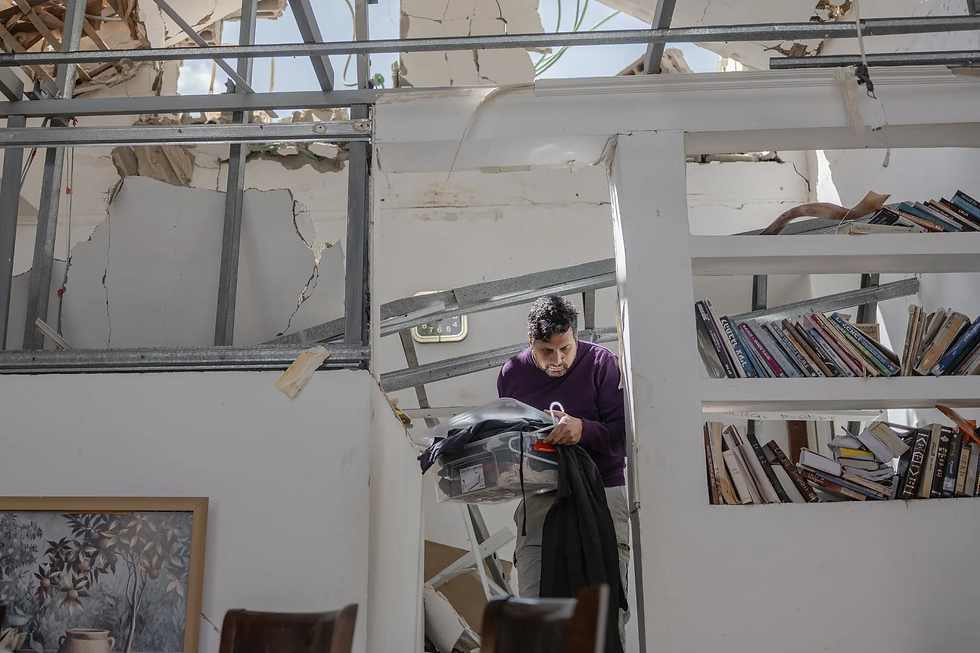
Shards of glass and charred debris littered the streets of Arad and Dimona on Sunday morning, hours after missiles from Iran struck residential neighborhoods in these small desert cities in southern Israel.
The blast in Arad on Saturday night carved out a crater of sand and twisted metal in a grassy courtyard and shattered windows more than half a mile away, according to residents. In Dimona, a missile smashed into a sandy yard between several apartment buildings.
About 175 people were injured in the two strikes, at least 10 of them seriously, according to the emergency and health services. There were no fatalities.
Dimona and Arad are the closest cities to Israel’s main nuclear research installation and reactor, one of the most guarded sites in Israel. Neither had been directly hit before, including in more than two years of wars in Gaza, Lebanon and Iran, according to local officials.
Yitzhak Salem, 62, was sheltering with his wife in a fortified safe room in his home in Dimona when the blast filled the room with dust and smoke. “It felt like a hurricane mixed with an earthquake,” he said.
The mayor of Dimona, Benny Biton, told Israeli news media that many residents in the destroyed buildings had avoided injury because they had made it to bomb shelters after receiving alerts of incoming missile fire.
In Arad, a city of roughly 30,000 people in the Negev Desert, three four-story apartment blocks closest to the impact site were set to be demolished, according to Kfir Levy, a spokesman for Arad’s City Hall.
Residents from surrounding buildings trickled in on Sunday morning to inspect the damage and try to collect their belongings. Some saw their hollowed-out homes for the first time.
Many of the 80 or so people wounded in Arad were not inside a shelter when the missile hit, Mr. Levy said. Among them were many older residents who struggle to descend multiple flights of stairs when warning sirens sound, he said.

Mike Getner, 45, a taxi driver who lives several blocks from the impact site in Arad, said the blast that followed the siren at roughly 10 p.m. felt like nothing he had experienced in his city before.
“The house shook, you could feel the blinds shudder, you felt the ground shaking,” he said. “You could tell it was right here.”
Isaac Waxler, a store owner who lives a block away from the impact site, said he was sheltering at home with his wife when they heard the blast. His son and eight grandchildren live in the buildings that surround the impact site.
“It was a terror,” Mr. Waxler said, describing the moments he tried to reach his son. His son managed to tell him he was OK before the lines went down, Mr. Waxler said. The family of 10 then moved to Mr. Waxler’s house to spend the night.
Israel Katz, the Israeli defense minister, said he had ordered the military to accelerate the demolition of houses in Lebanese towns close to the border. Israel has been carving out a military-controlled buffer zone inside Lebanese territory, which many Lebanese fear could become a renewed de facto occupation in the south of the country. In a statement, Katz said he had ordered the demolitions “along the lines of Rafah and Beit Hanoun” — two Gazan cities which were largely razed by Israeli forces during the two year war in the Palestinian enclave.

Israel’s defense minister announced that he ordered the country’s military to immediately destroy more bridges over the Litani River in southern Lebanon, part of an Israeli military campaign against Hezbollah that has displaced more than a million people in Lebanon. Israel Katz, the minister, said he had given the order to prevent Hezbollah from moving militants closer to the border with Israel in the country’s south.
March 22, 2026, 5:46 a.m. ETMarch 22, 2026
Sanam Mahoozi
Iran has entered its 23rd day of an internet blackout, according to the internet monitoring group NetBlocks. On the second day of the Persian New Year, many families and friends remain unable to communicate. But individuals affiliated with the authorities in Iran, who have access to privileged “white SIM” services, appear to still have access to the internet and social media, experts said.
March 22, 2026, 5:01 a.m. ETMarch 22, 2026
Reporting from Beirut, Lebanon
Lebanon Dispatch

The shirtless jogger, his headphones in and his back slick with sweat, ran past a row of tents pitched along the seafront in downtown Beirut, Lebanon’s capital. In one tent, a displaced family of four — uprooted by weeks of war that have convulsed the nation — watched him pass.
For a moment, the scene held its uneasy calm. The evening sun faded into the Mediterranean Sea, the steady rhythm of the waves softened the edges of the day, and the runner kept his pace, eyes forward. And then a deafening roar shattered it all: An Israeli airstrike had hit a nearby neighborhood, sending plumes of smoke into the sky.
“We chose the seaside because it is peaceful,” said Hussein Hame, 37, who, along with his wife and two children, was displaced this month from Dahiya, a collection of neighborhoods on the southern outskirts of Beirut where Hezbollah holds sway. “But this war finds you everywhere.”
War has returned to Lebanon, and the capital’s meandering seafront has become an unlikely front line. Here, a stark contrast has emerged: The displaced and destitute sit in the cold, while others live life as usual — jogging, cycling — amid the dizzying wealth and luxury that exist nearby.


In early March, Israel unleashed a barrage of attacks on Lebanon after the Iran-backed proxy group Hezbollah fired rockets at northern Israel following the U.S. and Israeli strikes on Iran. The violence has uprooted more than a million people, with Israel issuing evacuation warnings across much of southern Lebanon and in parts of Beirut and the eastern Bekaa Valley. Israel’s strikes have killed more than 1,000 people, injured more than 2,700 and put Lebanon, once again, on the precipice of disaster.
On the city’s seafront, the human toll is visible in stark detail: Tents line the promenade, cars serve as makeshift shelters and bundles of clothes scatter the sidewalks. Teenagers, with nowhere to go and no school to attend, roam around. Toddlers, hungry and exhausted, cry and fuss.
Families huddle through cold nights, lighting small bonfires that do little against the wind and rain. There is nowhere to shower, nowhere to change, barely enough to eat — especially difficult for those who were fasting during the Muslim holy month of Ramadan.
The displaced form a mosaic of Lebanon itself: locals uprooted from homes, businesses and farmlands. But there are also foreigners, many of whom are domestic workers and day laborers. They arrived from Africa, Asia and across the Middle East in search of better economic opportunities and safety only to find uncertainty.
A week into the fighting, an Israeli strike hit several cars along the seaside corniche, killing at least eight people and injuring dozens more, health officials said.
But even as suffering persists along the waterfront, a different reality unfolds beside it.


From the corniche, the city opens to a breathtaking panorama: the glittering Mediterranean, the rugged peaks of Mount Lebanon and the iconic Raouché Rocks rising from the sea.
The promenade is also one of the city’s most affluent stretches, lined with upscale apartments and hotels, luxury car dealerships and swanky restaurants with well-heeled patrons sipping cocktails. Those displaced share the same stretch with cyclists, joggers in sleek athletic wear, families out for evening strolls and fishermen casting lines from the rocks below.
On a recent afternoon, Vera Noon, who was walking along the seafront, described a swell of conflicting emotions. Some people moved along the corniche, walking their dogs and laughing as if nothing had changed, seemingly untouched by the surrounding suffering. And yet, she said, she understood that people were navigating the crisis in their own ways.
“They didn’t choose this war,” said Ms. Noon, a Lebanese doctoral student at the University of Edinburgh who is researching the connection between the Mediterranean and her country’s heritage.
The seafront, she said, offers a sanctuary for both those clinging to daily routines and those with nowhere else to go.
“The sea is the last refuge,” Ms. Noon said. “It gives people peace. They relax, it gives them calm.”


The Beirut seafront is no stranger to war.
In April 1973, Israeli commandos departed from this coastline after targeting members of the Palestinian Fatah organization who were operating in the city. In August 1982, an image of coastal buildings ablaze after Israeli bombardment appeared on the cover of Time magazine. During the 15-year civil war that ended in 1990, the waterfront was lined with bullet-scarred buildings.
In the years that followed, the area was rebuilt, most notably by the private development company Solidere, led by former Prime Minister Rafik Hariri, which reshaped downtown Beirut with high-rise buildings and commercial projects. That transformation came at a cost: Cafes, hotels and beach clubs privatized large stretches of the shore, putting access out of reach for many.
Even so, the public never fully let go. Activists organized campaigns, protests and legal challenges to preserve access to the sea.
At the same time, crises kept coming. A financial collapse in 2019 fueled an antigovernment revolt that pushed crowds demanding change onto the waterfront. In 2020, an explosion at Beirut’s port tore through the city, killing hundreds and devastating entire neighborhoods. Then came war with Israel in 2024, once again driving people toward the seafront in search of refuge.
Now, with conflict returning, many like Gizelle Hassoun, a 52-year-old bar owner, say they feel exhausted and detached — and are drawn back to the waterfront for a fleeting touch of normality.
“We are all in a state of bala mokh,” said Ms. Hassoun, using an Arabic phrase that literally means “no brain” but colloquially describes being mentally drained and numb.


During the 2024 war, she said, she and those around her rushed to help the displaced along the waterfront whose homes and businesses had been destroyed. This time, she was spent, and the famed Lebanese resilience that usually carried her was gone.
When the fighting between Israel and Hezbollah began on March 2, she didn’t bother to stock up or fill her car’s tank.
“This is sad, but maybe we’ve gotten too used to this,” she said, strolling along the seafront with a friend as the buzz of an Israeli drone cut through the air.
Not everyone coming to the waterfront carries the same weariness.
Mohammed Ismail has been returning to this stretch of Beirut’s coast for more than a decade. Usually, he lives in Dahiya, the Hezbollah stronghold that has been evacuated, and runs an electronics store there. But even since fleeing, he has made sure to come to the waterfront.
On a recent afternoon, he sat tanning in the sun, reading the Quran open in his lap as he fasted for Ramadan. It was the second time he had been displaced in less than two years. His mind sometimes wandered to hardship, he said, but he was trying to carry on as normally as he could.
Nearby, a group played padel, others smoked and chatted, and some exercised. For a fleeting moment, life felt ordinary.
“This is the best place to remove the stress from your life,” he said.


On some days, the tranquillity of the beach masks a deadly reality.
In mid-March, Israeli airstrikes tore through several cars along the corniche in the Ramlet al-Baida neighborhood, splattering the sidewalk with bloodied sand. Just days before, a suite in the four-star Ramada Plaza Hotel farther down the seafront was hit. Israel says its attacks are aimed at reaching Hezbollah operatives and their Iranian backers.
For those taking shelter along the waterfront, like Mr. Hame and his family, life now swings between dread and relief. The night that Ramlet al-Baida beach was struck, his children panicked and leaped onto him inside their tent. He held them and tried to calm them, he said. When that failed, he raced them on his motorcycle to a church east of Beirut where displaced people were offered shelter.
They stayed there for the morning, but soon after, he said, the children insisted on returning to the shore.
March 22, 2026, 4:55 a.m. ETMarch 22, 2026
Vivian Nereim Reporting from Riyadh, Saudi Arabia
A Qatari helicopter crashed in the Persian Gulf due to a technical malfunction during a routine operation, killing seven, according to statements from the country’s defense and interior ministries. Four were members of the Qatari armed forces, one was from Qatar and Turkey’s joint forces, and two were Turkish “civilian collaborators.”
March 22, 2026, 4:20 a.m. ETMarch 22, 2026
Sanam Mahoozi
Iran pushed back against claims that it had effectively closed the Strait of Hormuz, saying that the vital oil supply route was only shuttered to the country’s enemies. Ali Mousavi, Iran’s permanent representative to the International Maritime Organization, said that the strait was “open to everyone” except Iran’s adversaries, hours after President Trump on Saturday threatened to attack Iranian power plants if the waterway was not fully opened in the next two days.
March 22, 2026, 2:58 a.m. ETMarch 22, 2026
Reporting from Jerusalem
A person was killed in an Israeli town near the country’s northern border after fire from Lebanon, where Israeli forces have been fighting the Iran-backed militant group Hezbollah, according to Israel’s emergency rescue service. The Israeli military said the attack had caused damage and casualties and was under review. At least 14 people have been killed in Israel since the war with Iran began last month.
March 22, 2026, 2:27 a.m. ETMarch 22, 2026
Israel’s military said on Sunday morning that its defense systems were responding to missiles launched from Iran. Shortly afterward, it said that emergency teams were heading to a site in central Israel following reports of a strike. It did not provide further details.
March 21, 2026, 11:13 p.m. ETMarch 21, 2026
Saudi Arabia’s Ministry of Defense said it intercepted a ballistic missile launched toward Riyadh, its capital, while two others fell in an uninhabited area. It did not say where the missiles originated.
March 21, 2026, 11:10 p.m. ETMarch 21, 2026
Israel’s emergency rescue service said it treated 115 patients after Iranian missiles struck Dimona and Arad, including 11 in serious condition. In Arad, where most of the serious injuries occurred, paramedics described a scene of “extensive destruction” and “chaos” according to the rescue service. In Dimona, where one person was seriously injured, paramedics reported damage to residential structures and people who were trapped inside buildings.

Iranian state news agencies also carried a warning from the country’s armed forces that if Iran’s fuel and energy infrastructure is attacked, Tehran will target all energy infrastructure belonging to U.S. and Israeli allies in the region. The claim appeared to respond to President Trump’s threat on social media on Saturday evening that he would “obliterate” Iran’s power plants if the country does not fully open the Strait of Hormuz within 48 hours.
March 21, 2026, 9:15 p.m. ETMarch 21, 2026
White House reporter
President Trump, who days ago publicly called on Israel to avoid targeting Iranian energy sites for fear of triggering an escalating cycle of counterstrikes, threatened to hit Iran’s power plants if it did not “FULLY OPEN, WITHOUT THREAT, the Strait of Hormuz” within 48 hours. He said that American strikes on Iranian plants would start “WITH THE BIGGEST ONE FIRST.”
Iran’s largest plant appears to be its only operating nuclear power plant, at Bushehr. For decades, nuclear power plants have been considered off limits because of the obvious risk of environmental catastrophe. The U.S. has led efforts to keep Russia and Ukraine from firing near the Zaporizhzhia nuclear power plant since Russia’s invasion of Ukraine.
Bushehr is fueled by Russian-provided uranium and monitored by the International Atomic Energy Agency. It is not considered part of Iran’s nuclear weapons program. The spent fuel is returned to Russia.
March 21, 2026, 9:14 p.m. ETMarch 21, 2026
Islamic Republic of Iran Broadcasting, the state broadcaster, said that the Iranian missile strike on the city of Dimona was intended to target Israel’s nuclear facilities there. The report appears to be the first confirmation from Iran that Israel’s nuclear facilities — which were not damaged, according to the United Nations’ nuclear watchdog — were the focus of the attack.
March 21, 2026, 9:09 p.m. ETMarch 21, 2026
Israel’s military said early Sunday that it had begun a new wave of strikes on Tehran, targeting Iranian infrastructure.
March 21, 2026, 6:36 p.m. ETMarch 21, 2026

An Iranian missile penetrated Israeli defenses on Saturday and injured over 40 people in a southern Israeli city eight miles from the country’s main nuclear research facility, according to Israel’s emergency rescue services. There was no evidence that the nuclear site had been damaged in the attack, U.N. officials said.
The Tasnim news agency, which is affiliated with Iran’s security forces, reported that the missile, which hit a residential area in the small city of Dimona, was fired in retaliation for airstrikes on Iran’s nuclear facility in Natanz on Saturday and on the Bushehr Nuclear Power Plant on Tuesday.
The Israeli military has denied attacking the Natanz facility, and the U.S. military declined to comment.
A second missile caused damage in Arad, a city about 25 miles northeast of Dimona, leaving at least seven people seriously injured, according to Israel’s emergency services agency, Magen David Adom. Teams were searching for other casualties.
“This has been a very difficult evening in the battle for our future,” the Israeli prime minister, Benjamin Netanyahu, said in a post on X.
Dimona is a sensitive target because it sits so close to the Shimon Peres Negev Nuclear Research Center, thought by researchers to be connected to Israel’s nuclear weapons program, which the country has not publicly acknowledged.
After the strike, the United Nations’ nuclear watchdog, the International Atomic Energy Agency, said it had not received any indication of damage to the nuclear research center. The agency called for “maximum restraint” on military strikes in the vicinity of nuclear facilities.
The Israeli military said it had unsuccessfully tried to intercept the missile before it struck and had opened an investigation into what went wrong.
At least two people were wounded, according to Magen David Adom. A 10-year-old boy was listed in “serious” condition with shrapnel injuries, and a woman had “moderate” injuries from glass fragments. The others had only mild injuries.
arch 21, 2026, 3:29 p.m. ETMarch 21, 2026
David E. Sanger has covered five American presidents. He writes often on the intersection of technology and national security, and the revival of superpower conflict, the subject of his latest book.
News Analysis

Ever since President Trump began what he now delicately calls his “excursion” into Iran, Washington has been consumed by the question of when he would call it a day — even if many of his war goals remain unaccomplished.
On Friday evening, as he headed to Florida, Mr. Trump seemed to be designing that much-discussed exit. But he clearly has not yet decided whether to take it.
And there is mounting evidence — average gas price approaching $4 a gallon, infrastructure in ruins across the Persian Gulf, a decimated Iranian theocracy digging in and American allies at first rebuffing and now struggling with demands to patrol hostile waters — that the repercussions of Mr. Trump’s excursion may outlast his interest in it.
As always, Mr. Trump’s messaging is inconsistent, which his critics cite as evidence that he entered this conflict with no strategy and his followers cheer as strategic ambiguity. With thousands of additional Marines headed to the region and the pace of American and Israeli attacks quickening, Mr. Trump told reporters on Friday he had no interest in a cease-fire because the United States was “obliterating” Iran’s missile stocks, navy, air force and defense industrial base.
Hours later, perhaps sensitive to a Republican base understandably nervous about the political effects, he posted on his social media site that “we are getting very close to meeting our objectives as we consider winding down our great Military efforts in the Middle East.”
But his latest list of those objectives left out a few of his previous goals and watered down others. He made no mention of defeating the Islamic Revolutionary Guards Corps, which appears to remain in power, along with Mojtaba Khamenei, who has succeeded his father as supreme leader, though he has yet to be seen or heard in public. Mr. Trump also omitted any message to the Iranian people, whom he told only three weeks ago: “When we are finished, take over your government. It will be yours to take.”
And after insisting in the failed negotiations that led up to the war that Iran had to ship all of its nuclear material out of the country — starting with the 970 pounds of enriched uranium that are closest to bomb-grade — he suggested a new goal. “Never allowing Iran to get even close to Nuclear Capability,” he wrote, “and always being in a position where the U.S.A. can quickly and powerfully react to such a situation.”

That is, essentially, where the United States was after it buried Iran’s nuclear program in rubble last June. The sites have remained under the watchful eye of U.S. spy satellites.
Mr. Trump ended the posting with a new demand for American allies, whom he had frozen out of his deliberations before starting the war, and gave no warning to prepare for its consequences. “The Hormuz Strait will have to be guarded and policed, as necessary, by other Nations who use it — the United States does not!” American forces would help, he said.
“Think of it as the new Trump Doctrine for the Middle East,” Richard N. Haass, the former president of the Council on Foreign Relations, who served on the National Security Council and at the State Department during the Persian Gulf War and the Iraq war, wrote on social media.
“We broke it, but you own it.”
Mr. Trump’s shifting goals continued into Saturday evening. Just a few days ago, he was calling on Israel to avoid targeting Iranian energy sites, for fear it would lead to an escalating round of retaliatory counter-strikes across the Gulf. But on Saturday, he threatened to hit Iran’s power plants if it did not “FULLY OPEN, WITHOUT THREAT, the Strait of Hormuz” within 48 hours.
He said that U.S. strikes on Iranian plants would start “WITH THE BIGGEST ONE FIRST.” Iran’s biggest plant appears to be its only operating nuclear power plant, at Bushehr. For decades, nuclear power plants have been considered completely off limits for strikes because of the obvious risk of environmental calamity.
This is not where Mr. Trump expected to be after three weeks of war.
Foreign leaders, diplomats and U.S. officials who have spoken with the president said that in the first week he voiced expectations that Iran would capitulate. That was clear in Mr. Trump’s demand on March 6 for Iran’s “unconditional surrender.”
The demand was mystifying, said one European diplomat with long experience dealing with Iran, given the country’s competing power centers, its national pride and a Persian state that has existed within the rough boundaries of modern-day Iran, enduring many rises and falls, since the days of Cyrus the Great around 550 B.C.
(That demand was also missing from his latest set of objectives. The White House has since said that the president does not expect a surrender announcement from Iran, but that Mr. Trump will determine when Iran has “effectively surrendered.”)
Iran’s refusal to “cry uncle,’’ as Mr. Trump termed it to reporters on Air Force One, has been only one of the surprises to the president in recent weeks.
The first was the crisis in the energy markets, which the International Energy Agency has called “the largest supply disruption in the history of the global oil market.” It has sent Mr. Trump and his aides scrambling. They have promised releases from the Strategic Petroleum Reserve, which was only 60 percent full, reflecting a lack of planning. Over the past week the Treasury Department has issued licenses for the delivery of Russian and Iranian oil already at sea. In other words, to calm the markets, the president has approved enriching an adversary that is at war with Ukraine, an American ally, and another that is at war with the United States.
So far, the effects are minimal. Brent crude closed at around $112 a barrel on Friday after the Treasury announcements, and Goldman Sachs warned on Thursday that if ships were reluctant to make their way through the Strait of Hormuz, prices could remain high into 2027.
The Iranians clearly understand that market chaos is their one remaining superweapon. On Saturday, Tehran warned it could set fire to other facilities in the Middle East. The United States believes the country entered the war with 3,000 or so sea mines — some of which are believed to have been destroyed — and the United States has focused on destroying small boats in the Iranian fleet that are targeting tankers associated with American allies.

“All it takes is for one of those things to get through to shut down traffic,” said John F. Kirby, who served as both Pentagon and State Department spokesman after retiring as a naval officer. “The fear alone can be paralyzing to the shipping industry, as we have already seen.”
Mr. Trump’s second surprise was his sudden need for allies. He didn’t imagine it at the beginning of the conflict, the defense minister of one Gulf nation said recently, because he thought the war would be short. But patrolling the strait, and other checkpoints, appears to be a task that could last months or years.
His third surprise was the absence of any uprising among either the Revolutionary Guards or ordinary Iranians. Treasury Secretary Scott Bessent said in the Oval Office this past week “we are seeing defections at all levels as they’re starting to sense what’s going on with the regime.” But American and European intelligence officials say they have no evidence of such defections — even after Israel targeted, and eliminated, Iran’s supreme leader, its top security and intelligence chiefs and many top military officials.
All that could yet come. Wars are not won or lost in three weeks. But Mr. Trump entered the Iran war after enjoying the fruits of quick victories. A bombing run over Iran’s three major nuclear sites in June was a one-evening expedition, essentially burying the country’s nuclear stockpiles and wiping out thousands of its centrifuges, which are used to enrich uranium.
The commando raid to seize Nicolás Maduro of Venezuela from his bed in Caracas was similarly swift. And so far, the government Mr. Trump left in place — essentially Mr. Maduro’s government — has been compliant. That operation has helped Mr. Trump destabilize Cuba, which has lost the Venezuelan fuel supplies that it has long depended on. The other day the electric grid in Cuba collapsed, and administration officials have been openly suggesting that the government will, too.
Perhaps those quick results encouraged Mr. Trump to believe the U.S. military was all-powerful, and that the mullahs and generals and militias that run Iran, a country of 92 million people, would crumble. Perhaps he rushed.
Military historians will be dissecting this conflict for a long time. But for now it is clear that Iran is a different kind of challenge. Mr. Trump started using the word “excursion” to suggest this is just a short trip, a brief diversion. But there is no real end in sight.
March 21, 2026, 12:46 p.m. ETMarch 21, 2026
Reporting from Washington

Iran’s attempted missile attack on Friday on a joint U.S.-British military base in the Indian Ocean, 2,500 miles away, immediately prompted questions of how far Tehran’s weapons can reach.
Before the current war on Iran, President Trump raised similar fears, noting in his State of the Union address that Iran was “working to build missiles that will soon reach the United States of America.”
But for now, Iran’s missiles cannot reach the United States, and as the failed strike on the military base on Diego Garcia in the Indian Ocean demonstrated, the farther Iran fires, the less reliable its missiles and the less accurate its attacks become.
Iran fired two missiles at Diego Garcia, said a U.S. official, speaking on condition of anonymity. One failed mid-flight and the other was shot down by an American warship. The official added that the launch had surprised the United States because of its range.
Lt. Gen. Eyal Zamir, the Israeli military chief of staff, discussed the missile attack on Diego Garcia in a video statement on Saturday night, saying Iran had fired a “two-stage intercontinental ballistic missile with a range of 4,000 kilometers” at “an American target” on the island on Friday. He did not elaborate, except to say that the attack underscored that Iran’s military capabilities could threaten Europe, not just Israel.
The strike came before the announcement that Britain would allow the United States expanded use of its bases, including at Diego Garcia. A senior Western military official, speaking on condition of anonymity, said the attack may indicate that Iran is trying to force the United States to spread out its defenses, and not merely focus on defending bases in the Middle East.
Tom Karako, the director of the Missile Defense Project at the Center for Strategic and International Studies in Washington, said the 2,500-mile distance was “beyond what we and they usually advertise” as the range of Iranian missiles.
“Iran has made its missile program a top priority for many years, and have displayed solid rocket motor plans,” Mr. Karako said. “It’s not a surprise that hard work yielded more substantial capability than some of the more optimistic publicly stated estimates. This is one reason why the United States and our European friends have been deploying missile defenses for quite a while now.”

The United States has missile-defense facilities in Romania and Poland that are nominally meant to address the threat of Iranian missiles.
A report by the Defense Intelligence Agency last year concluded that Iran did not have ballistic missiles capable of hitting the United States, and that it might take as long as a decade for it to have up to 60 intercontinental ballistic missiles.
At a Senate hearing this week, Tulsi Gabbard, the director of national intelligence, affirmed the D.I.A. report that suggested Iranian intercontinental ballistic missile development was years away.
But others have estimated a shorter timeline.
Senator Tom Cotton, Republican of Arkansas and the chairman of the Senate Intelligence Committee, said he feared Iran could make a functioning ICBM in six months if it paired its space launch technology with its medium-range missile technology.
John Ratcliffe, the director of the C.I.A., said Mr. Cotton was right to be concerned. He said if Iran was unimpeded it would be able to develop missiles that could threaten the continental United States, though he did not cite a time frame for such a development.
“It is one of the reasons why degrading Iran’s missile production capabilities that is taking place right now in Operation Epic Fury is so important to our national security,” Mr. Ratcliffe said.
Other experts cautioned that it was hard to draw many conclusions about Iran’s capabilities until more is known about the type of missile that was fired. But Nicholas Carl, a fellow at the American Enterprise Institute’s Critical Threats Project, said it affirmed Iran’s ability to fire beyond 1,200 miles with its current capabilities.
“That upends some of the assumptions that many have long had about the Iranian threat,” Mr. Carl said. “Even if Iran cannot reliably hit precise targets at that range, this raises the question of whether it can reach that far with cluster munition warheads, which it has fired repeatedly at Israel in order to maximize collateral damage and terrorize civilians — rather than to destroy discrete military targets.”
Aaron Boxermanin Jerusalem contributed reporting.